
The Biggest Threats, Trends, and Tools You Need to Know
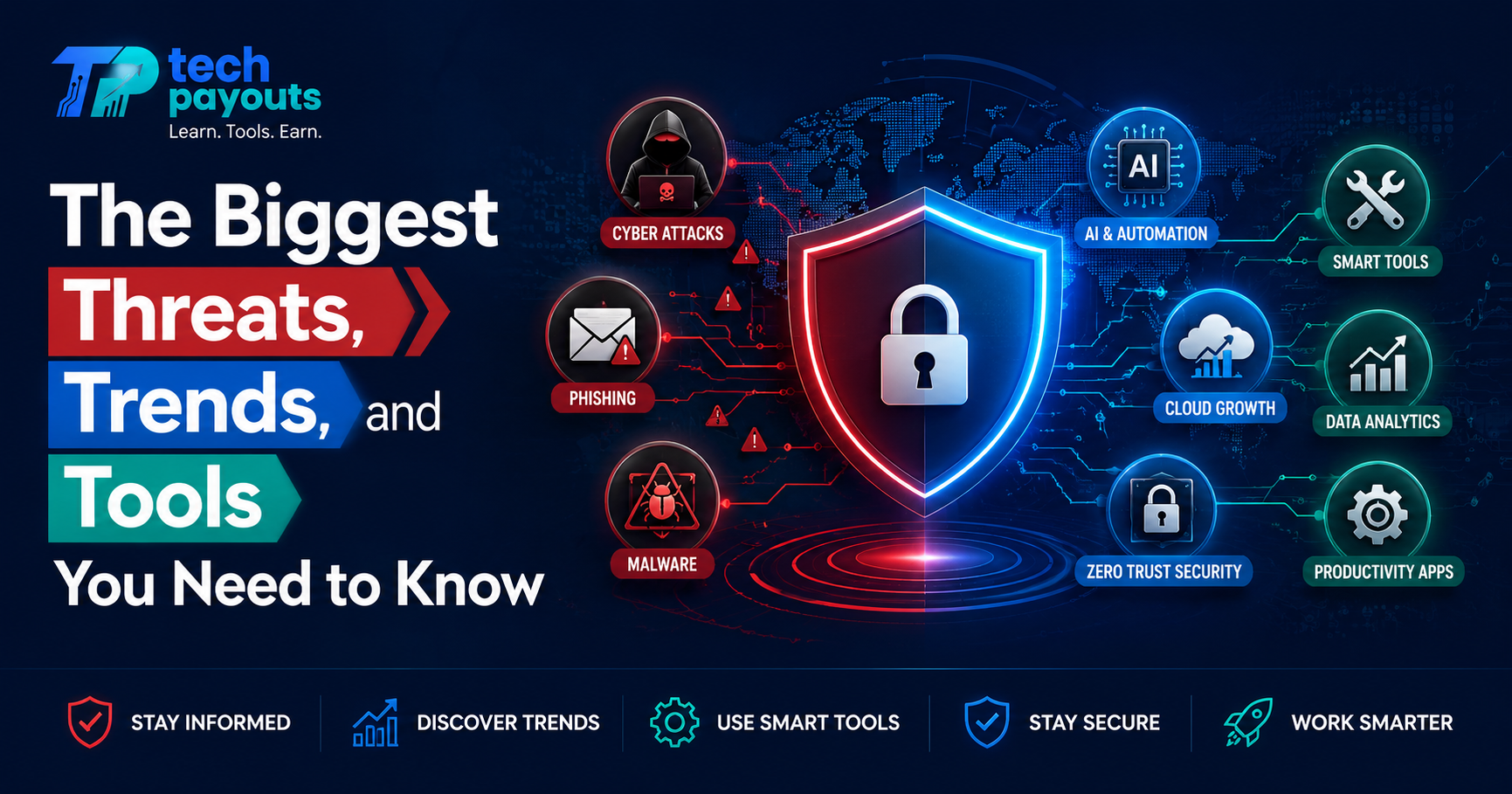

Cybersecurity in 2026: The Biggest Threats, Trends, and Tools You Need to Know
Cybersecurity has never been more important — or more complicated. In 2026, the attack surface has expanded dramatically as AI-generated threats, cloud misconfigurations, ransomware-as-a-service operations, and nation-state actors push organizations to their limits. At the same time, the defenders are fighting back with equally powerful tools: AI-driven threat detection, zero-trust architecture, and a new generation of security platforms built for the modern enterprise. This article breaks down the most critical cybersecurity threats of 2026, the trends shaping how organizations respond, and the tools leading security teams are using to stay ahead.
The Current Threat Landscape: What Has Changed in 2026
The cybersecurity threat landscape in 2026 is fundamentally different from even two years ago. Three shifts stand out above all others. First, AI has become a weapon. Attackers are now using large language models to craft hyper-personalized phishing emails, generate malware variants that evade signature-based detection, and automate reconnaissance at a scale no human team could match. Second, the attack surface has exploded. The proliferation of IoT devices, connected vehicles, AI agents with external tool access, and edge computing nodes has created millions of new entry points that legacy security tools were never designed to cover. Third, ransomware has professionalized. Ransomware-as-a-service (RaaS) operations now operate with support desks, affiliate programs, and negotiation specialists — making sophisticated attacks accessible to low-skill threat actors.
1. AI-Powered Cyberattacks

The most significant shift in offensive cybersecurity in 2026 is the weaponization of AI. Threat actors — ranging from nation-state groups to financially motivated criminal organizations — are using AI models to dramatically accelerate and improve every phase of the attack lifecycle. AI-generated spear-phishing emails now mimic a target’s writing style, reference real recent events, and pass all traditional email filtering rules. Deepfake audio and video are being used in business email compromise (BEC) attacks to impersonate executives in real-time calls, convincing employees to authorize fraudulent wire transfers. Automated vulnerability discovery tools powered by AI can scan public-facing infrastructure and identify exploitable weaknesses faster than any human penetration tester. Security teams that are not deploying AI on the defensive side are already fighting an asymmetric battle.
2. Ransomware-as-a-Service (RaaS)
Ransomware remains the most financially destructive category of cybercrime in 2026. The professionalization of the RaaS ecosystem means that sophisticated ransomware operations are no longer limited to elite hacking groups. Affiliate programs allow low-skill actors to deploy proven ransomware payloads in exchange for a revenue split with the platform operators. Notable RaaS groups active in 2026 have adopted double and triple extortion tactics — encrypting data, threatening to publish it publicly, and simultaneously launching DDoS attacks against victims to maximize pressure. Critical infrastructure sectors including healthcare, energy, and water utilities remain the highest-value targets due to their low tolerance for operational downtime and historically underfunded security postures.
3. Supply Chain Attacks
Supply chain attacks — where adversaries compromise a trusted software vendor or hardware supplier to gain access to downstream targets — have become one of the most effective and difficult-to-detect attack vectors in 2026. The logic is straightforward: instead of attacking hundreds of well-defended enterprise targets individually, compromise the single software update mechanism or open-source library they all depend on. High-profile incidents in recent years have demonstrated that even organizations with mature security programs can be compromised through trusted third-party software. In 2026, security teams are extending their zero-trust principles to encompass every software dependency, not just user identities.
4. Prompt Injection and AI Agent Attacks

As AI agents become embedded in enterprise workflows — reading emails, browsing websites, executing code, and interacting with internal systems — a new class of attack has emerged: prompt injection. In a prompt injection attack, malicious instructions are hidden inside content that an AI agent processes, hijacking the agent’s behavior to perform unauthorized actions. A compromised AI agent with access to email, calendar, and file systems is a high-value target. An attacker who can redirect such an agent through a malicious webpage or document could exfiltrate sensitive data, send unauthorized communications, or pivot deeper into an organization’s infrastructure without ever touching a traditional exploit. Security tooling specifically designed for agentic AI environments is one of the fastest-growing segments of the cybersecurity market in 2026.
5. Nation-State and Critical Infrastructure Threats
Nation-state cyber operations have intensified in 2026, with critical infrastructure — power grids, water treatment facilities, financial systems, and telecommunications networks — as primary targets. These attacks are often not immediately destructive. Instead, advanced persistent threat (APT) groups focus on long-term access and pre-positioning: establishing persistent footholds in critical systems that can be activated during geopolitical escalation. The blurring of the line between cyber espionage and cyber warfare means that organizations operating critical infrastructure must now defend against adversaries with nation-state resources and patience measured in years rather than days.
The Most Important Cybersecurity Trends in 2026

The defensive side of cybersecurity is evolving just as rapidly as the threat landscape. The key trends shaping how organizations protect themselves in 2026:
- Zero-trust architecture: The principle of “never trust, always verify” has moved from security philosophy to operational standard. Every user, device, and application is continuously authenticated and authorized regardless of network location. Zero-trust adoption has accelerated significantly following high-profile breaches that exploited implicit trust within corporate networks.
- AI-driven threat detection: Security operations centers (SOCs) are deploying AI models that can correlate signals across millions of events per second, identify behavioral anomalies, and surface genuine threats from the noise — drastically reducing mean time to detect (MTTD). Human analysts are increasingly focused on investigation and response rather than alert triage.
- Extended Detection and Response (XDR): XDR platforms unify telemetry from endpoints, networks, cloud environments, and identity systems into a single detection and response layer, replacing the fragmented tool stacks that slowed incident response in prior years.
- Secure Access Service Edge (SASE): SASE converges networking and security into a single cloud-delivered service, providing consistent security policy enforcement for remote users, branch offices, and cloud workloads without requiring traffic to backhaul through a central data center.
- Post-quantum cryptography: With the National Institute of Standards and Technology (NIST) having finalized the first post-quantum cryptographic standards, organizations are beginning the multi-year process of migrating encryption systems to algorithms that will remain secure against quantum computing attacks.
- Security for AI systems: Protecting AI models themselves — from training data poisoning, model theft, and adversarial inputs — has emerged as a distinct security discipline with its own tools, frameworks, and standards.
Top Cybersecurity Tools and Platforms in 2026
The cybersecurity vendor landscape has consolidated considerably, but several categories of tooling are seeing the highest investment and adoption among enterprise security teams in 2026:
- CrowdStrike Falcon: The market-leading endpoint detection and response (EDR) platform, now extended with AI-native threat intelligence and identity protection capabilities across cloud and on-premises environments.
- Microsoft Sentinel: Cloud-native SIEM and SOAR platform deeply integrated with the Microsoft 365 and Azure ecosystem, offering AI-powered detection rules and automated playbooks for incident response at scale.
- Palo Alto Networks Cortex XSIAM: An AI-driven security operations platform that consolidates data from across the enterprise stack to automate threat detection and response with minimal analyst intervention.
- Wiz: The dominant cloud security posture management (CSPM) platform, helping organizations identify misconfigurations, exposed credentials, and toxic risk combinations across multi-cloud environments.
- Cloudflare Zero Trust: A widely adopted SASE platform providing secure remote access, DNS filtering, browser isolation, and DLP controls delivered from Cloudflare’s global network.
How Businesses Should Approach Cybersecurity in 2026
For organizations of any size, the cybersecurity priorities in 2026 follow a clear hierarchy. First, get identity right — the majority of breaches still originate from compromised credentials, making multi-factor authentication (MFA) and privileged access management (PAM) foundational investments. Second, know your attack surface — you cannot defend what you cannot see, and continuous attack surface management (ASM) tools now make it possible to maintain real-time visibility into every externally exposed asset. Third, build for resilience — assume breach, invest in detection and response capabilities, and test your incident response plan before you need it. Fourth, address the human layer — security awareness training remains one of the highest-ROI investments, as social engineering continues to be the entry point for a significant majority of successful attacks.
- Implement multi-factor authentication across all user accounts and privileged systems
- Adopt a zero-trust network access model, eliminating implicit trust within the perimeter
- Conduct regular penetration testing and red team exercises
- Maintain an up-to-date software bill of materials (SBOM) for all applications and dependencies
- Deploy endpoint detection and response on every managed device
- Establish and regularly test an incident response and business continuity plan
- Train employees to recognize phishing, social engineering, and deepfake-based attacks
- Begin assessing cryptographic dependencies in preparation for post-quantum migration
Conclusion
Cybersecurity in 2026 is a discipline defined by speed, scale, and the dual-edged nature of AI. The same technology that enables AI agents to automate business workflows is being weaponized to automate attacks at a pace no human defender can match unaided. The organizations that will come out ahead are those that embrace AI-driven defenses, apply zero-trust principles consistently, and treat security not as a compliance checkbox but as a continuous operational discipline. The threat landscape will keep evolving — the question is whether your security posture is evolving faster.

almuntasim
Technology correspondent covering software architectures, system designs, and future technology trends.
Discussion
0 CommentsLeave a Comment
Share your thoughts with the community.
The Future, Delivered.
Join 85,000+ technology leaders receiving our weekly deep-dive into the innovations shaping our world.
Leave a Reply